
ELD Compliance in 2020: What You Need to Know

The Electric Logging Device (ELD) Rule was put into effect by the Federal Motor Carrier Safety Administration (FMCSA) on December 18, 2017. This mandate was softly enforced, giving the transportation industry time to become compliant by December 16, 2019. This is the date to ensure all trucks had a working electronic logging device (ELD). Below is more information on the upcoming changes regarding ELD compliance:

What is an Electronic Logging Device?

Before delving into what changes can be expected in 2020 with ELD compliance, it’s important to understand what ELD means. An ELD is a device that tracks service hours. It is designed to replace devices like an Electronic on-Board Recorder (EOBR) or an Automatic On-Board Recording Device (AOBRD). These devices track Record of Duty Statuses (RODs). ELDs must meet Federal Motor Carrier Safety Association standards to be considered in compliance with the ELD mandate.

ELD Compliance in 2020: What You Need to Know

ELD mandate compliance has been a gradual process as mentioned above. However, most motor carrier operations were ELD mandate compliant within the first months of the year 2018.  Operations that had previously used AOBRDs were given until December 16, 2019, to completely switch to an FMCSA approved ELD device. By 2020, ALL commercial motor vehicles are required to have an approved ELD installed to be considered compliant.

The Grace Period For Compliance is Slowly Ending

The grace period once given by officials to allow companies time to completely switch to ELDs is slowly ending. However, presently, there is still a bit of a grace period. Truck drivers who are pulled over for roadside inspections must have the following on board to avoid penalties.

Must Have Items to Avoid Penalties:

·       Instructions explaining the data transfer mechanism that is supported by ELD.

·       An instruction sheet that reports any ELD malfunctions.

·       A regulation-compliant, registered, certified ELD.

·       A user manual for the ELD.

·       Paper log sheets, serving as a back-up.

What Happens if Drivers Are Found Non-Compliant?

Drivers who are pulled over without the above items, without a grandfathered-in AOBRDs or who are not exempt from the mandate will be subject to a penalty in the form of a fine. This fine can be substantial, which could amount to thousands of dollars!

Upcoming Concerns and Issues About The ELD Mandate

Admittedly, adhering to the mandate and making the necessary changes to become ELD compliant is a massive undertaking. After all, there are thousands of trucks on the road at any given time in the United States. However, the safety improvement associated with the ELD mandate is expected to dramatically improve roadway conditions for both professional and pedestrian drivers. Consequently, the logistics of ELD implementation is worthwhile.

Problems That Could Creep Up in The Coming Months and Years

The following are some upcoming issues that might be problematic in the upcoming months and years relating to ELD compliance:

·       Crowded Rest Stops: ELD mandate determines the amount of rest hours a trucker should log. The need for them to log rest hours in order to be ELD compliant could lead to overcrowded rest stops.

·       More Fines And Tickets: Operators who continue to push back against the ELD mandate will face ever growing penalties, which means more tickets and fines. This problem will diminish as more and more operators become compliant.   

·       ELDs Aren’t Always Allowed: Some areas of the nation, like government contractor facilities, do not allow vehicles on property that have ELDs.

Additional Questions Answered About ELD Compliance

Who Must Comply With ELD Mandate?

The ELD mandate applies to most commercial motor vehicles. According to estimates, this represents over 3.5 million truckers. If drivers wonder if they will fall under the mandate and be required to comply, they should consider the fact that in most cases, if they currently keep a logbook, they will be required to follow the ELD rule.

Are Any Drivers or Companies Exempt From The Rule?

Yes, there are some types of trucks that do not have to comply with the ELD mandate. They are as follows:

·       Short-haul drivers. These drivers log no more than 8 days of driving during a 30-day period and currently maintain a Record of Duty Status (RODS).

·       Short-haul drivers who have and maintain RODS.

·       Tow-away drivers.

·       Any vehicles that have a pre-2000 model engine.

What Are The ELD Mandate Compliance Requirements?

The following are the requirements to be considered ELD compliant:

·       Carriers and drivers must keep all supporting documents (as mentioned above) for a stipulated period of time.

·       All ELDs should be shared with law enforcing authorities and safety officials.

·       ELDs should be certified.

·       ELDs should conform in both technology and design to FMCSA standards.

How to Know if a Specific Device is ELD Compliant?

According to the FMCSA, you can access the registered ELD devices that are compliant with the mandate. They are listed here. Owners and operators should be aware that ELD systems that are cellular based can be a risky proposition. If a driver happens to travel outside the boundary of good cell service, their cellular coverage can become spotty or nonexistent. This, in turn, can mean driving data won’t be synced properly. The FMCSA recommends an ELD system that relies on USB and Bluetooth connections to relay data between the engine and the drivers’ mobile apps to prevent this problem.

Can The Use of Mobile E-Logs Take the Place of ELDs?

No. The ELD mandate demands ELD to be connected to the engine of the vehicle. Therefore, even an E-log is not a sufficient substitution and will not be considered ELD compliant.

The ELD Compliance Mandate is Worthwhile

The implementation of a new ELD system into thousands of trucks nationwide can seem arduous. However, the safety benefits are substantial enough to make the ELD mandate worthwhile. In addition, even if drivers don’t want to embrace the change, they are legally required to do so as of mid-December 2019. Therefore, implementing the mandate sooner rather than later is advisable.


Looking for a truck driving job? Apply Now or Search Driving Positions.


You may also enjoy this article: Dashcams For Truckers: What You Need to Know

Team Trucking in 2020 and Beyond

Team trucking is on the rise in 2020, and it is poised for years of growth.

What are the main reasons team trucking is taking off?

  • Friends are teaming up and hitting the road.
  • Many women are getting into trucking as a second career, and many enjoy coming on board as team truckers.
  • New truckers are needed in the industry, and team trucking offers an option that might increase the driving population.
  • The trucking industry is beginning to realize great untapped potential in the team approach to driving.

At Barr-Nunn Transportation, we have positions open not just for solo drivers, but also for team truckers. Here’s what it’s about, and some aspects to consider if you’re thinking of driving as a team member.

Are You Cut Out for Driving as a Team Trucker? 

While many truckers prefer to drive alone, some prefer the team approach in which two truckers alternate shifts between on-duty and off-duty on their drives. With two people sleeping in shifts, the truck keeps rolling and the load keeps moving. This is good for the trucking company. And drivers make money for their total miles – which, of course, add up much faster when two people are taking turns at the wheel. 

And yes: team driving is in high demand in the industry in 2020. The growth outlook is very good. At Barr-Nunn, we point out that the team approach can definitely be a way into a trucking career in 2020 and beyond.

If you’re thinking of becoming a team driver in the near future and would like to prepare mentally, the following are some insights.

It Comes Down to Your Outlook, Preferences, and Partner

First, assess your personality. Are you an extrovert? Or do you just think you’d like to travel with a pal? If so, team driving might be just the factor that makes a trucker’s life work for you.

For people who like to handle things alone, team driving might just become nerve-wracking. You know yourself best.

Even though you’re part of a team, you’re not always interacting with each other, because one or the other is usually sleeping. (This is a good place to note that only two hours of off-duty time is allowed in the passenger seat. Drivers need to be in the sleeper berth for 8 of the mandatory 10 off-duty hours.)

As for breaks, team partners have to make their schedules fit their partners’ schedules, and their delivery timetables as well. That can get stressful unless the pair is remarkably compatible.

The main thing is this. You’re riding with another human being for days or weeks. If you no longer click with or lose trust in, your partner, this makes it nearly impossible to keep working together. But for some people who work with us at Barr-Nunn, partner driving makes their career fulfilling. 

Pairing Up: A Driving Partnership Can Be a Life Partnership

Your partner must share the work equally with you and must be someone you can trust completely. Maybe it’s no surprise that some of our ace teams are married couples.

For the couple that’s cut out for it, driving with your life partner can be a unique and precious benefit. Rather than being apart while the other is on the road for long hauls, the two partners can work together and look after each other.

Did you know women truckers accumulate more mileage than men do? It’s one of the notable recent trends in trucking and it happens because female truckers often drive in teams and can switch with a teammate whenever one driver gets to their driving limit. Women tend to have excellent safety records and are less likely to leave the industry, too. Are you looking for a partner with great stamina? There is so much to be said for women truckers. If you happen to be one of them or want to get started, we heartily welcome you.

For the Right Partners, Team Driving Has Its Perks

Team driving is different — some drivers love it and some don’t. There’s someone there to help with the inspections and fixes. There’s someone to guide you as you’re backing up or parking in a tricky spot.

And, of course, there is someone to take the loneliness out of the longer rides. Back in the heyday of CB radio, there were plenty of conversations. Today, it’s different. Everyone has smartphones but no one is allowed to talk on them while driving. 

Being away from home for long hauls can take its toll on some people. Interesting studies have appeared in recent years about truck drivers’ mental health and how important social relationships can be to protecting everything from heart health to longevity. Close relationships with other people can uplift our moods, strengthen our immune systems, and increase our life spans. It’s a fascinating line of research and adds yet another reason to appreciate the friendships forged for life in the trucking world.

You might have a good friend in the industry, and decide to pair up. If your friend does not have OTR driving qualifications, speak with us to see about bringing your friend on board with CDL and OTR training.

Will Teamwork Make Your Dream Work?

Yes, we couldn’t resist that one.

Ask yourself:

  • Can I trust my partner 100%?
  • Does my partner have the stamina and mental strength to perform consistently on the road, day and night?
  • And what about the other person’s view? Am I good company in tight quarters? Am I a good communicator? Am I organized and tidy? Do I mind handling more than a 50-50 share of the work when the other person is under the weather?

Respect for the other person involves being sensitive about details that you wouldn’t bother about if it were just up to you. When sharing the same space for extended periods, it’s important to do all you can to avoid a cold, pay special attention to hygiene, avoid bean dip and burritos, keep the music volume down, and avoid bumpy or sharp moves. 

Are You OK With All That?

Now to add one more (really big) thing. Both of you will be working out your sleeping patterns and getting used to your off-duty time while the truck’s rolling.

Have you tried to sleep on a train or plane? If so, you know what we mean. Will you be refreshed? How will you split day and night driving? What if you need to change shifts? Will you be able to work out your preferences?

Sleep is a major factor in keeping you safe, and safety is your first priority, so think carefully about this: In a very real sense, you’ll need to be able to trust your partner with your life, and vice versa.

If you’ve already qualified for OTR, you have had a taste of team driving. As part of your training course, you drove with a mentor. Were you comfortable with that – or itching for the time you’d be on your own? That tells you a lot about whether you’re cut out for team trucking.

At Most Companies, the Pay Might Not Differ Greatly From the Solo Driver’s Rate. But at Barr-Nunn, You Will Earn More as a Team.

There are a lot of talks and promotional material out there suggesting that team driving means exceptionally high pay. But it’s just straight math. The more miles driven, the more pay is earned. Sources show the pay per mile averaging in the range of .32 per mile up to .50 per mile across the country, for each partner in a team.

If you were driving around the clock and around the calendar, you could pull in a gross yearly pay per driver of $61,000+, or 122K+ per couple, at the average U.S. transportation company. But we’re all human. Even in teams, we can’t drive constantly. And loads are not always available, even when drivers are. Most driving teams are out on the road an average of 35 out of the 52 weeks in a year. It varies.

That said, if life partners are also trucking partners, and the pair drives with a Top Pay Certified trucking company, the situation can be particularly beneficial for them. Their pay may be shared, and because they help each other on the road, this option can be a great way to make a living. It’s quite typical for team drivers to pull in several hundred dollars in extra income each month.

Interested? Talk With Us About Team Trucking.

We’re a trucking company that’s keen on team truckers. The industry has not recruited teams to the level it should, and we’re making sure we let drivers know this is an option. We’re working to be the best trucking company for team drivers, in 2020 and beyond.

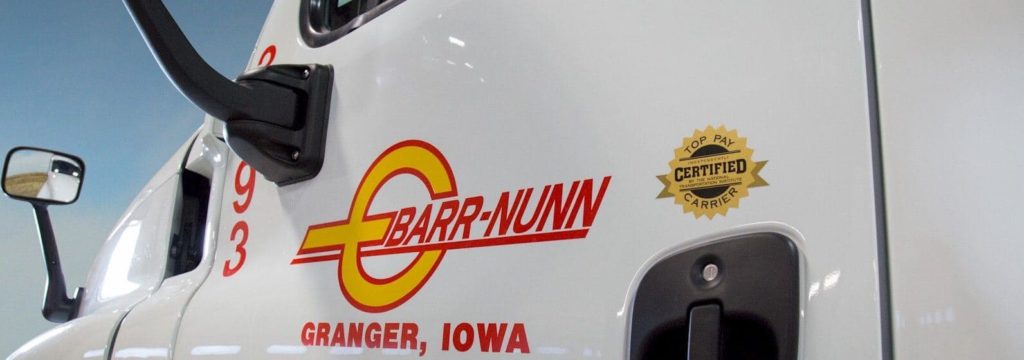
Based in Granger, Iowa, with terminals in NC, PA, and OH, we’re also a National Transportation Institute Top Pay Certified Carrier. So, please contact us to find out more about how team trucking can meet your career aspirations and your financial goals. We appreciate your consideration of a career as a team trucker. 

Looking for a truck driving job? Apply Now or Search Driving Positions.

Top Five Tips For Winter Truck Drivers

During winter months, when roadways can become icy and snow-covered, safety is of paramount importance. After all, even the most experienced commercial drivers can experience a weather-related accident. Reduced traction combined with poor visibility can cause an extreme challenge to even highly skilled drivers. Here are our Top Five Tips For Winter Truck Drivers to help improve roadway safety for truck drivers, even during extreme weather conditions.

Top Five Tips For Winter Truck Drivers

1.) Slow Down

Most accidents involve speed in some way. Therefore, it’s important for drivers to slow down, especially during winter driving conditions. Drivers must compensate for poor traction and visual hindrances by slowing down, giving themselves extra time to react if something should happen in front of them. According to a Road & Track article, when temperatures are between 25 and 35 degrees, tires can lose their grip, even more than they might at lower temps. This means that colder temperatures don’t always mean worse roadway conditions and showcases how even moderately cold temps can lead to dangerous driving conditions. Therefore, winter weather driving means slowing down!

2.) Put Extra Space Between Vehicles

A wet roadway means it takes a vehicle at least twice as long as normal to stop. On icy roads, this number jumps up to 10 times as long. Consequently, it’s important for drivers to leave ample space between their trucks and the vehicle in front of them. This will give drivers the necessary to stop if the need should arise.

3.) Avoid Sudden Actions

During cold, wet, icy or snowy weather, it’s important for drivers to refrain from sudden actions. This means drivers should not accelerate, brake, corner or any other driving-related action suddenly. Consistent speed is of vital importance to prevent the truck from sliding due to a slippery roadway. If sudden braking is necessary on a slick roadway, evasive action is likely the better option, rather than slamming on the brakes. A driver traveling at around 25-30 mph, which is ideal for poor driving conditions, should consider maneuvering around obstacles with a deceleration in order to avoid a potential collision.

4.) Be Aware of Potential Hazards

Bridges and overpasses can become especially dangerous during winter driving conditions. These locations tend to ice quickly, before the rest of the roadway, and they can even be neglected during road preparation for winter weather. Therefore, it’s important for truck drivers to slow down when approaching bridges to reduce their risk of sliding on black ice or slick patches.

5.) Be Prepared

Another way truck drivers can reduce their risk of having an accident on a winter roadway, is to prepare ahead of time. Drivers should check their truck’s tire pressure, antifreeze levels, engine oil and lights before traveling. It’s also a good idea to have a mechanic inspect the truck before winter weather begins, to ensure it is in tip-top shop for winter driving.

What Else Drivers Can do to Stay Safe

Having an accident due to slipping and sliding isn’t the only risk associated with winter weather driving. Icy, snowy roadways can cause all sorts of issues, some of which can strand truck drivers on the road, without the ability to get to a warm, safe location. Consequently, truck drivers should prepare an emergency kit of sorts in the unfortunate event that they find themselves stranded, waiting on roadways to reopen. (listed below)

Drivers might be tempted to walk to find help if their truck is stuck on the roadway, but in many cases, if they can’t see a place nearby to walk, it’s best to stay put, bundle up and wait for the storm to pass. It’s important to remember that carbon monoxide poisoning is possible if the truck’s exhaust pipe gets clogged with snow. Therefore, drivers should check their exhaust pipe regularly and keep windows slightly cracked to ensure proper ventilation. It’s also a good idea to only run the engine for around 10-15 minutes every hour.  

The following are some supplies every truck driver should have on hand when driving during the winter months to keep them safe while stranded or help get them moving once again if possible: Emergency Kit:

  • Tire chains.
  • Flashlight.
  • Extra clothing, for layering.
  • Blankets.
  • Windshield fluid.
  • Rain gear.
  • Gloves.
  • Bag of sand, salt or kitty litter to give traction on icy parking lots or roadsides.
  • Jumper cables.
  • Brushes or snow scrapers.
  • Putty knife or hammer, for frozen air tanks.

General Tips For Winter Truck Drivers Keep Safe on Icy Roadways

In addition to all the tips listed above, truck drivers should also keep the following general advice in mind:

Warm-up The Windshield

A dirty windshield presents a problem when it’s icy and freezing cold outside. When the temperature plummets, it can be difficult to get the defroster to work. Some truckers like to add brake line antifreeze to washer fluid to address this issue. This prevents the fluid from freezing on the window the second it hits when it is freezing outside. Drivers should also give themselves enough time to warm their trucks up properly before traveling. This includes time to properly warm-up or defrost the windshield.

Address Frozen Brakes

Brakes can also be frozen during winter weather conditions. If they become frozen, there are two things drivers should check to address this dangerous situation. They are as follows:

  • Frozen Drums: If the shoe is frozen solid to the drum, drivers often can gently tap the drum with a hammer (mentioned above) to unfreeze.
  • Frozen Valve: A frozen valve can be remedied by pouring methyl hydrate through the system.

Understand Waiting it Out is Sometimes Best

If truck drivers know severe winter weather is coming and there is simply no way to avoid the area, they are often better off just waiting out the weather, instead of risk getting stuck on the highway. In general, exit ramps are plowed after main highways, then rest areas. Therefore, truck drivers should wait out winter weather at a hotel, 24-hour restaurant, or gas station parking lot, instead of trying to travel. Doing so when they know bad weather is inevitable and unavoidable can prevent them from getting snowed in on the highway.

Are you a truck driver? Let us know if you have more tips for winter truck drivers.

Looking for a truck driving job? Apply Now or Search Driving Positions